


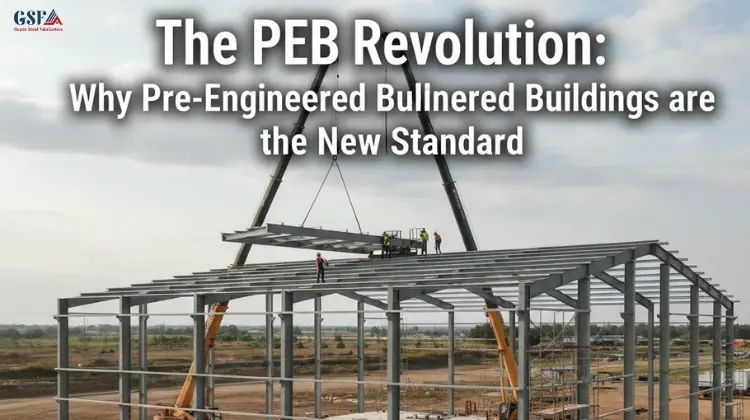
What’s This Article About? Pre-Engineered Buildings (PEBs) are revolutionizing modern construction by offering faster project delivery, cost efficiency, and genuine quality through factory-controlled manufacturing. With reduced timelines, optimized steel usage, and sustainable practices, a reliable pre-engineered building manufacturer is becoming essential for industries seeking durable, scalable, and future-ready infrastructure.
Gone are the times when warehouse construction took months to complete. To meet the needs of industries with larger requirements in a shorter time, Gupta Steel Fabricators has made a revolutionary move, becoming a pre-engineered building manufacturer. Engineered using the best quality steel and FRP (Fiberglass Reinforced Plastic) buildings for warehouses, logistics centers, sheds, and even cold storage, GSF promises to deliver performance that is built to last while being cost-effective.
With the advent of technology, it has become easier to navigate problems both quickly and efficiently. Companies like Tata BlueScope Steel have also mentioned in their table of differences in 2021 that PEBs are 30% lighter than conventional buildings. This makes it durable, efficient, and easy to construct. Pre-engineered buildings are making a lot of difference in the segment, but at the same time, it is important to understand the science behind this.
What Are Pre-Engineered Buildings?
Pre-engineered buildings, or PEBs, are steel structures designed and manufactured in a designated factory environment. These buildings are so convenient that once you place an order, the PEB manufacturer will take the estimated time as per the requirement, deliver the structural components, and assemble them at your location. Due to this very flexibility, conventional/traditional methods differ a lot from such PEBs.
Find out the key differences between PEBs and traditional steel/concrete buildings
| Feature | Pre-Engineered Buildings (PEBs) | Traditional Steel/Concrete Buildings |
|---|---|---|
| Fabrication | PEB parts are made of steel in the factory and then delivered to the final client before being bolted. | Traditional buildings are made up of raw materials like steel, concrete, and bricks. Cutting and welding are done on-site. |
| Structure | PEBs are at least 30% lighter than conventional construction. | Traditional buildings are heavier and require deep footings. |
| Design | Custom-built and software-driven designs. | Built with architectural complexity. |
| Secondary Members | Uses lightweight ‘C’ and ‘Z’ purlins. | Uses heavy ‘I’ and ‘C’ sections. |
| Delivery Speed | 6–12 weeks depending on structure. | 20–30 weeks for normal construction. |
| Estimated Costs | Low-cost due to less labor and faster build. | Higher cost due to labor and material use. |
| Sustainability | Environmentally friendly with less wastage. | High energy consumption and wastage. |
Due to precision, accuracy, and effectiveness, PEBs are a better choice than the traditional methods.
Will Pre-Engineered Buildings Replace Conventional Construction?
Today, the world is changing at a faster pace than it was a decade ago. Since PEBs offer 40-50% reduced time in delivering the structures, it is not a surprise that a PEB building manufacturer is shifting their preference. For a certain manufacturer, faster project completion means a faster process for further work.
The second reason is cost-effectiveness. Due to inflation, things are getting costlier day-by-day. Let’s take an example. A traditional concrete warehouse building takes 90 days to complete. In opposition, if a proposal to construct a PEB warehouse specifies 45 days. You are a manufacturer. Which one would you choose? Of course, the PEB proposal. Because things get done in weeks, a manufacturer is able to save a lot on labor, raw materials, and deliveries.
Last but not least, due to factory-controlled production, PEBs impart rare pollution, contributing to environmental health in a positive way. Reduced material wastage leads to a happy and assured quality.
What Is the Actual Role of a Pre-Engineered Building Manufacturer?
Apart from providing tailor-made solutions to the clients, the pre-engineered building manufacturer’s role is extensive and ranges from start-to-end construction, delivery, and assembly. Let’s explore the role in depth.
A PEB building manufacturer handles everything from structural engineering and Building Information Modeling, which are the design representations of 3D models of the final structure. They are also involved with the final delivery on the site.
A PEB manufacturer is involved with the research, survey, procurement, and design of the structure. Therefore, such people also act as QC heads from the start to the end. One mistake can cost a lot if things remain unchecked.
As a building manufacturer, it is the role of such a person to come up with innovations in production, and even after that. Manufacturers are using high-tensile steel and advanced coating technologies to make sure that the building lasts for a period of more than 50 years.
How Does the Future of PEB Construction Look?
As we are moving towards an industry-focused construction, PEBs will not be limited to just sheds and warehouses, but their focus will be increasing across commercial and infrastructure sectors. Going further, PEBs will also have a strong alignment with green energy principles and other sustainability initiatives.
So, given that the future holds a bright light for PEBs, choose the best pre-engineered building manufacturer for your betterment and overall advancement.
Tags
#GSF Industries
Share

