


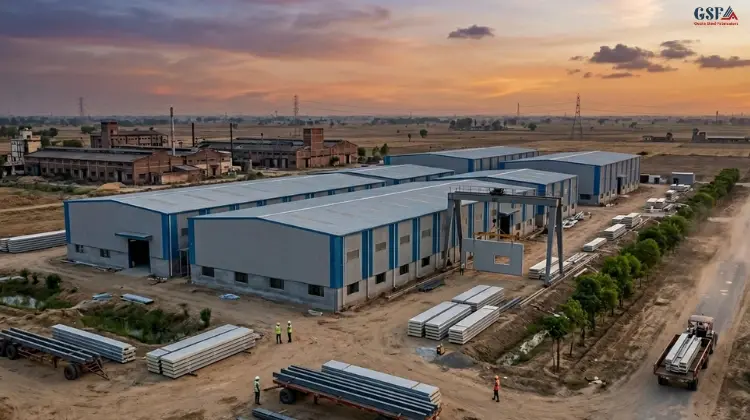
What’s the Article About? This article explores how Pre-Engineered Buildings (PEBs) are revolutionizing Punjab’s industrial landscape. It highlights the advantages, focusing on speed, cost efficiency, flexibility, and sustainability compared to traditional construction methods.
While we are all aware of the fact that Punjab has always been and still is a powerhouse of industries, with Ludhiana popularly known as the “Manchester of India.” Be it agriculture or the MSME-driven manufacturing ecosystem, as the industrial growth accelerates, traditional brick-and-mortar structures are no longer keeping up with the speed and efficiency of what the modern industries are demanding today. And that’s exactly where the prefabricated structures, particularly GSF Industries’ pre-engineered buildings, are changing the game.
Let’s get more into the matter and understand how this shift is a more efficient, cost-effective, and environmentally conscious construction approach.
Why Prefabricated Structures Are Gaining Ground In Punjab
No matter the project size, every industrial worker operates on tight deadlines and budgets. Prefabricated buildings address these issues easily and take the challenges head-on. Unlike traditional construction, PEB components are designed, engineered, and manufactured in a controlled environment before being assembled on-site. Not only does this reduce the construction time drastically, but it also helps the business scale production faster than expected, further resulting in speedy efficiency and profitability.
There’s one more reason why PEB building manufacturers like GSF Industries are getting so much spotlight. The consistency in quality. Given that most of the work is carried out in factories using advanced and technically sound machinery, the chances of human errors are reduced, resulting in stronger and more reliable structures that meet global standards.
Coming to Punjab’s industrial advancement, it is because the buildings stand strong even after such a diverse climate that can come with environmental stress. So, it should be safe to say that PEBs are designed in such a way that they are precise, durable, and weather-resistant, still having structural integrity over time.
The Sustainability Advantage Of Peb Construction
Sustainability today isn’t a buzzword anymore; it has become a necessity of the time. No matter what industry you are in, things must align with environmental responsibilities. This is the point where many industrialists are switching to pre-engineered buildings.
- As a leading PEB manufacturer in Punjab, GSF Industries focuses on minimizing material waste during production. In comparison with the conventional methods, PEBs are quite compatible, quick, and economical from every angle. This reduces environmental impact and also helps businesses cut costs.
- The second benefit is energy efficiency. PEB structures can be modified to include insulation systems, natural lighting, and other ventilation solutions that can help in reducing energy consumption.
- Next, water usage is also lower in PEB constructions. Traditional building methods require large quantities of water, whereas PEBs use minimal water, making it a more eco-friendly option, especially in regions facing water problems.
Therefore, the rise of pre-engineered buildings in Punjab doesn’t just show improvement in construction but the reshaping of how industries operate in the state, advanced and frugal.
The Road Ahead With GSF Industries
It’s undeniable that Punjab’s industrial sector is evolving. With this, the construction practices must evolve with it. For that, the prefabricated structures, led by innovative GSF Industries’ PEB building manufacturer solutions, are paving the way for a future that is faster, greener, and more efficient. Being a reliable pre-engineered building manufacturer in Punjab, you will also have the option to avail yourself of customized solutions.
PEBs can be customized to fit specific operational requirements, regardless of whether it is a big industrial shed, a cold storage facility, or a small production unit. To make this possible, the need for trustworthy building solution providers will only grow as industries expand. Therefore, selecting a pre-engineered building manufacturer means investing not only in construction but also in sustainability and long-term efficiency.
What This Symbolizes For Industry Players
Since PEBs are revolutionizing the construction of industrial buildings in Punjab with their quicker construction, you’ll also experience reduced environmental impact and long-term cost savings. So, it’s time to think outside the box when planning your next industrial project. Partner with an experienced PEB manufacturer in Punjab, like GSF Industries, that understands your business needs and provides a solution with the future in mind.
To build more sustainably and intelligently, contact us right away to start effective industrial growth.
FAQs
- What is a Pre-Engineered Building?
-
A pre-engineered building is a structure designed and fabricated in a factory using steel components, which are then assembled on-site. This ensures faster construction, better quality control, and reduced waste compared to traditional construction.
- Why are industries in Punjab choosing PEB structures?
-
Industries prefer PEBs because they offer faster project completion, cost efficiency, and flexibility. With Punjab’s rapidly growing industrial sector, PEBs help businesses set up operations quickly without compromising on quality.
- Are PEB structures sustainable?
-
Yes, PEB structures are highly sustainable. They reduce material wastage, use recyclable steel, require less water during construction, and can be designed for better energy efficiency.
- How does a PEB building manufacturer ensure quality?
-
A reliable PEB building manufacturer uses advanced machinery and standardized processes in controlled factory environments. This minimizes errors and ensures consistent quality across all components.
- Is a PEB structure more cost-effective than traditional construction?
-
While initial costs can be similar, PEBs offer long-term savings through reduced construction time, lower maintenance, and energy efficiency, making them more cost-effective overall.
Share

