


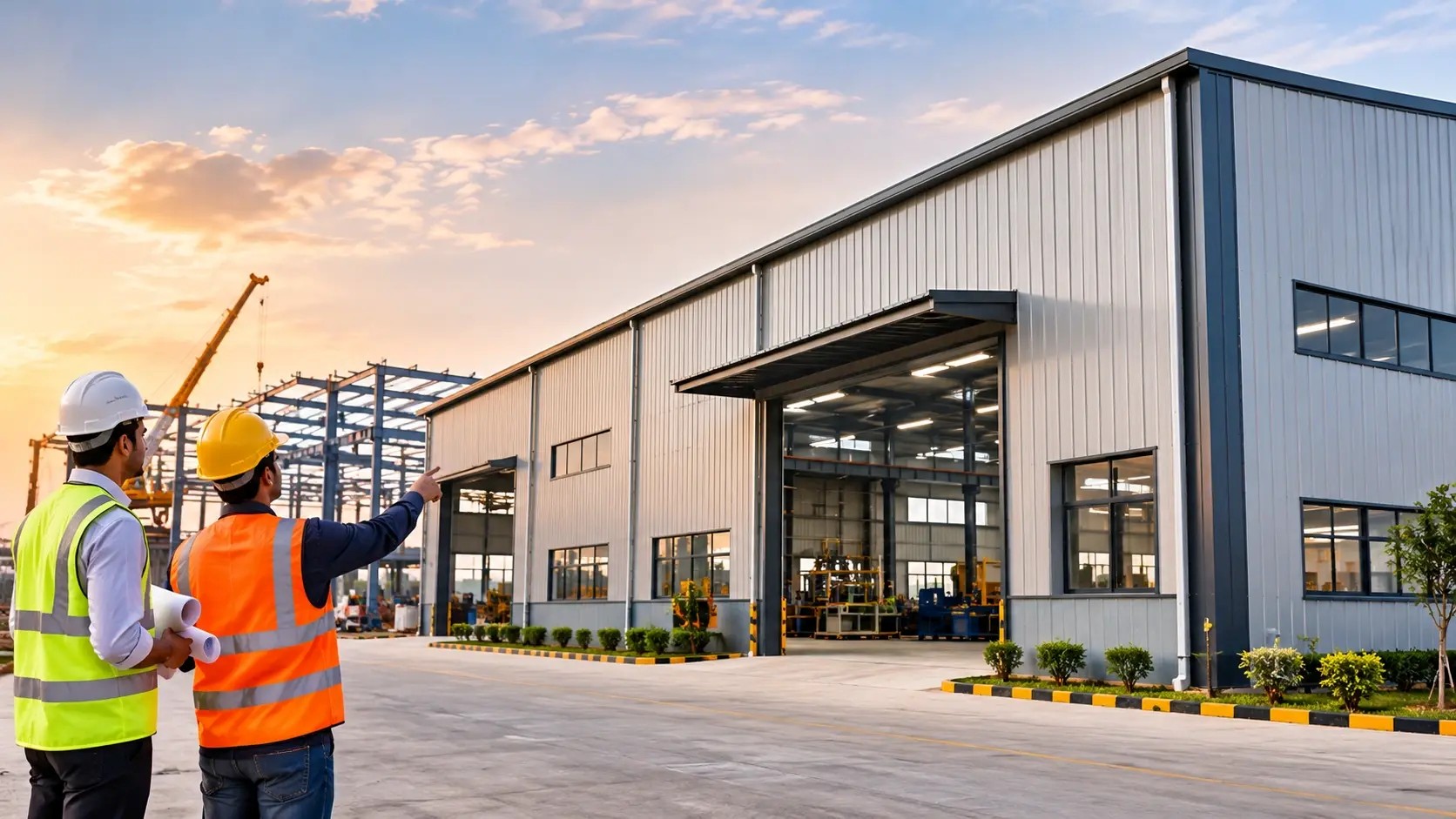
What’s the article about? This article explains how India’s manufacturing growth is driving demand for prefabricated buildings, faster factory construction and flexible industrial infrastructure.
India’s manufacturing sector is rapidly expanding, resulting in a growing demand for industrial infrastructure. Built quickly, efficiently, and affordably, businesses are investing in new production facilities and expanding existing plants in a variety of industries, including electronics, automobiles, pharmaceuticals, food processing, and renewable energy.
Today, manufacturers are increasingly demanding GSF Industries’ factory structures that shorten construction timelines, support modern production requirements, and allow for future expansion without major structural changes.
Why Is Factory Expansion Increasing in India
Government initiatives such as Make in India and the Production Linked Incentive (PLI) schemes are lifting up domestic manufacturing and attracting industrial investments. As manufacturing capacity expands, companies will require more than just land. They will require production halls, warehouses, assembly units, storage areas, and supporting infrastructure.
This will naturally increase the demand for construction methods that can help businesses transition from project planning to actual operations more efficiently.
Why Are Prefabricated Buildings Gaining Popularity
Traditional construction demands major on-site activities such as structural fabrication, material handling, and installation. Prefabricated construction involves preparing structural components off-site and assembling them at the project location. Pre-engineered building construction is done with engineered steel components that are specifically designed for the building’s intended use and other requirements.
The prefabrication approach is beneficial in more than just one way:
- Faster Construction: Off-site fabrication and foundation work can be done in parallel, reducing overall project timelines.
- Cost Management: Proper fabrication and material utilisation help to keep construction costs under control.
- Design Flexibility: Buildings are designed to fit specific production layouts and operational requirements.
- Future Expansion: Suitable structural designs allow for additional space or extensions as manufacturing capacity grows.
These benefits make PEB construction in India a much better option for industrial developers and manufacturing companies.
Which Industries Are Driving PEB Applications in India
Prefabricated buildings are in high demand across a wide range of industries. Some common PEB applications in India are:
- Automobile Manufacturing: This involves large production halls, assembly facilities, and component manufacturing units.
- Warehousing and Logistics: Includes distribution centres, inventory storage buildings, and loading facilities.
- Food Processing: Used for production units, packaging facilities, and storage structures.
- Pharmaceuticals: Designed to meet specific production and utility requirements.
- Electronics Manufacturing: Assembly plants and manufacturing facilities that need organised production layouts.
- Renewable Energy: Industrial facilities that manufacture solar equipment and conduct related operations.
This range motivates businesses to look beyond traditional factory construction.
What Does the Future Hold for Pre-Engineered Buildings in India
As India’s manufacturing ecosystem grows, the demand for adaptable industrial infrastructure is expected to remain high. Pre-engineered buildings are a practical approach for businesses looking to set up new facilities or expand existing operations.
So, are you considering opening a new factory or expanding an existing one, too? Collaborate with GSF Industries, an experienced PEB manufacturer in India and explore building solutions that meet your operational needs.
FAQs
- 1. What is a pre-engineered building?
-
Pre-engineered buildings are steel structures designed and fabricated using engineered components for faster on-site assembly.
- 2. Why are PEBs suitable for factories?
-
Because they provide design flexibility, faster construction, and the potential for future expansion.
- 3. Which industries most commonly use PEBs?
-
Industry sectors include automotive, pharmaceuticals, food processing, electronics, and warehousing.
- 4. Are prefabricated buildings cost-effective?
-
Well, yes. They can reduce construction time, labour requirements, and material waste, resulting in lower overall project costs.
- 5. Could PEBs be expanded in the future?
-
Yes, PEB structures can accommodate future extensions and additional operational space if properly planned.
Share

