


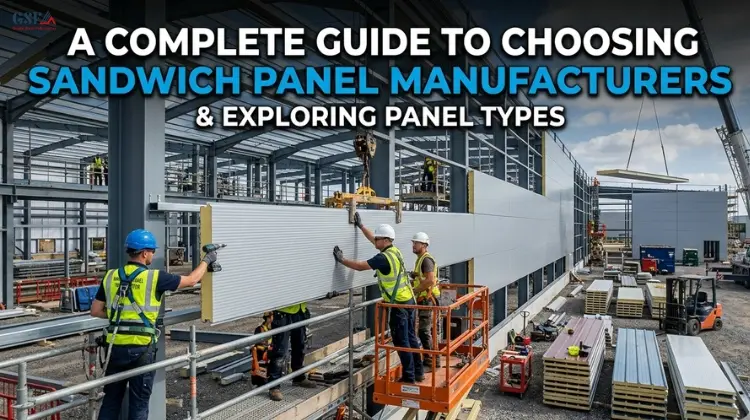
What’s the Article About? This guide simplifies the process of selecting the right sandwich panels and manufacturer by breaking down panel types, applications, and key decision factors. It highlights the importance of quality, insulation, and PEB integration while helping you avoid costly mistakes.
There are three things that any construction landscape asks for: speed, efficiency, and reliability. These aren’t really asked for but are, in general, expected to be true and prevailing. Therefore, to ease the operation even further, sandwich panels have made their superlative entry. Such elements have already carved a strong position, especially in the industrial and commercial sectors. From warehouses to cold storage units, the panels offer a perfect balance of strength and insulation, required for a real structure.
Although full of advantages, the choice of which sandwich panel manufacturer to use comes first. Only if you have a reliable source like GSF Industries will you be able to make sure that your goals about structural integrity, deadlines, and long-term cost savings are being managed and on point.
What Are Sandwich Panels, And Why Are They So Widely Used
As its name suggests, sandwich panels are engineered buildings that are made of three layers. Two outer metal sheets, which are typically galvanized steel or aluminum, along with one insulating core like PU (Polyurethane), PIR (Polyisocyanurate), EPS (Expanded Polystyrene), or Rockwool (Mineral Wool). The structure that comes as an output gives panels their unique strength-to-weight ratio and other required insulating properties.
Unlike conventional materials that are heavy, take time to build up, and are costly, sandwich panels are designed for stability and performance. That’s why one needs to know the exact use of such panels and why they are used:
- They help regulate internal temperatures and, therefore, help in reducing costs.
- Their simple installation also reduces HVAC costs.
- Due to their lightweight construction, sandwich panels lower the structural load.
- Known for faster installation, they cut unnecessary project timelines.
- They have clean and modern aesthetics, which are also one of the reasons for their usage.
What Are The Major Types Of Sandwich Panels
Well, now that we have been thorough about what a sandwich panel is, let’s talk about its types. Choosing the right panel is important because it heavily depends on your project requirements. The heavier the work you do, the better the panel needs to be. There are four major types, namely PU, PIR, EPS, and Rockwool.
PU or Polyurethane Sandwich Panels
You might be acquainted with these types of panels. If not, then know that they are known for their exceptional insulation properties. Such panels are widely used in industries that are temperature-sensitive and critical. PU panels are ideal for cold storage, food processing, and pharma companies. They have high energy efficiency along with moderate fire resistance.
PIR or Polyisocyanurate Sandwich Panels
PIR panels are the upgraded version of PU panels with more enhanced and heightened fire resistance. Known for their amazing fire performance, such panels are suitable for industrial and commercial buildings. Their long-lasting ability and durability help them to fit the bubble of insulation and safety requirements.
EPS or Expanded Polystyrene Sandwich Panels
For the projects that are budget-constrained or temporary, or just want to incorporate something new, EPS panels are a cost-effective option. Why? First of all, they are lightweight and easy to handle, are cost-effective, and have lower insulation in comparison to PU/PIR sandwich panels. Therefore, EPS panels fit the temporary structures and sit in offices.
Rockwool Sandwich Panels
These types of panels are preferred in high-risk environments, where the stakes are really high. This is because of their superior fire resistance. With excellent fireproofing technology, they are also equipped with strong sound insulation. They are heavier than all the others mentioned above and cater to the needs of industrial zones, factories, and high-temperature areas.
How To Choose The Best Sandwich Panel Manufacturer
While we have covered the types of sandwich panels available and their properties, it is equally important to choose the right sandwich panel manufacturer. Why? Let’s read:
- Proven Experience: Manufacturers like GSF Industries deliver consistent quality and handle complex requirements seamlessly. This is because they have worked in the space since its beginning, making them the ultimate masters of the art.
- Product Range: A sandwich panel manufacturer must offer various types of panel options. This is so because you might once need a PU panel or the other, depending upon your needs.
- Certifications & Compliance: Make sure that your manufacturer adheres to ISO standards and other fire and safety regulations.
- Customization Properties: Since every project is different and serves distinct purposes, look for a manufacturer who can bend panels as per your needs and aspirations.
- Integration with PEB Solutions: Working with a manufacturer who also has thorough experience with PEB building manufacturers ensures that execution is smooth, from design to final installation.
- After-Sales Support: Till the sale, everything seems fine, but always choose a manufacturer who gives technical guidance, installation support, and maintenance advice, further adding long-term value.
Final Words: What Is The Future Of Sandwich Panels?
The industry is evolving rapidly with new techniques to work faster and smarter. Sandwich panels are one such revolution in the scope. The innovations are focused on sustainability and performance, with eco-friendly insulation materials, enhanced fire-resistant technologies, smart panels with improved thermal efficiency, and adoption in residential construction. Therefore, things are changing and evolving for the good of life.
So, are you ready to choose the right sandwich panels and partner with GSF Industries as your reliable PEB building manufacturer to future-proof your next project?
FAQs
- EPS, and Rockwool sandwich panels for my project?
-
Although it depends on your priority, if insulation is critical (like cold storage), go for PU or PIR. For fire safety, Rockwool is ideal. If you have budgetary issues and insulation needs are moderate, EPS works well. Always align the panel type with your building’s purpose and safety requirements.
- What thickness of sandwich panel should I select?
-
Panel thickness depends on insulation needs, climate conditions, and building usage. For example, cold storage facilities require thicker panels (60mm–150mm), while warehouses may function efficiently with 30mm–50mm panels. A reliable manufacturer or PEB building manufacturer can guide you based on project specifications.
- How important is compatibility with a PEB building manufacturer?
-
It’s extremely important. When sandwich panels are designed to integrate with PEB structures, installation becomes faster, alignment is precise, and structural performance improves. This reduces on-site errors and ensures better long-term durability.
- What certifications should a sandwich panel manufacturer have?
-
Look for ISO certifications, fire safety compliance (such as ASTM or EN standards), and quality assurance processes. These ensure that the panels meet durability, insulation, and safety benchmarks required for industrial and commercial construction.
- Are sandwich panels suitable for long-term industrial use?
-
Yes, high-quality sandwich panels are designed for long-term performance. With proper installation and minimal maintenance, they can last 20–30 years or more, even in demanding industrial environments.
Share

