


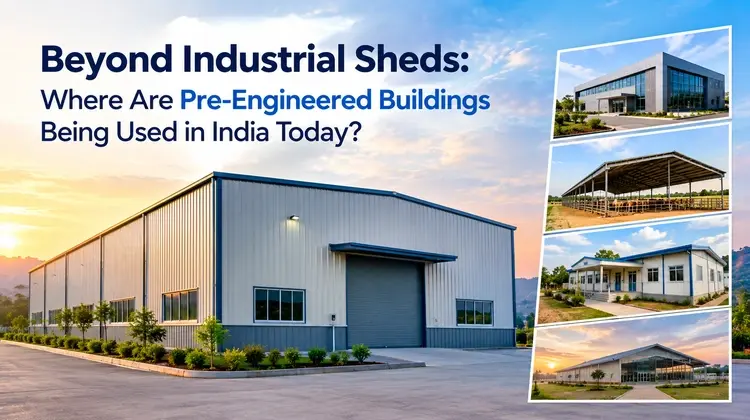
What’s the article about? This article explains how pre-engineered buildings in India have advanced beyond traditional industrial sheds and helps Indian buyers understand why application-specific engineering is important when selecting a PEB system.
Pre-engineered buildings in India have come a long way from being the basic factory sheds you might know. Today, modern steel building systems are coming to the forefront to tackle projects that need open, usable floor space, fast turnaround times, and the flexibility to grow as needs change. This shift makes perfect sense given the boom in India’s logistics, manufacturing, and digital sectors.
In the first half of 2025, industrial and warehousing leasing totalled a record 27.1 million square feet across eight major cities. This level of demand is boosting the use of PEBs, making them one of the fastest-growing options in modern construction. Aside from numbers, let’s look at what pre-engineered building applications are in real life.
Where Else Are Pre-Engineered Buildings Making Their Mark?
1. Modern Warehousing and Logistics Parks
Warehousing is hands-down one of the biggest drivers of PEB growth in India. Rapidly expanding e-commerce platforms, third-party logistics providers, and major retail chains all need massive, column-free spaces with high ceilings, dedicated loading docks, and adaptable layouts. GSF Industries’ Pre-engineered building construction makes it easy to integrate heavy-duty racking systems, automated material handling, and future expansion plans. As supply chains stretch deeper into Tier 2 and Tier 3 cities, PEB distribution hubs are popping up all over the country.
2. Cold Storage and Food Processing Units
Absolutely. Temperature-controlled environments, such as cold storage hubs, dairy processing plants, grain silos, and food production facilities, are increasingly built with PEB structural frameworks paired with insulated sandwich panels. Speed of construction is a huge advantage here, but so is functionality: these frames easily accommodate specialised HVAC, strict hygiene zones, integrated drainage, and heavy processing equipment.
3. Commercial and Retail Spaces
PEBs have stepped far beyond industrial sites into customer-facing commercial projects. Today, they power modern auto showrooms, retail outlets, corporate offices, service centres, and exhibition halls. Thanks to their design versatility, businesses can create expansive open floors and striking custom facades that look polished and professional. In fact, contemporary construction guidelines now feature PEBs as a primary option for commercial, institutional, and recreational buildings
4. National Infrastructure Development
You will find PEB construction in India playing key roles in major transit and infrastructure networks, from railway station concourses and metro rail depots to airport support facilities, air cargo terminals, and maintenance workshops. As India invests heavily in upgrading its transport networks, PEBs offer the speed, structural integrity, and customizability needed to hit tight project deadlines.
5. Data Centres and High-Tech Facilities
Driven by cloud adoption, AI workloads, and digital expansion, India’s data centre capacity topped 1,500 MW in 2025. While data centres require complex, highly specialised engineering, prefabricated steel structures are frequently used for supporting shells and auxiliary buildings. When designed right, they seamlessly integrate structural loads, fire safety, cooling channels, and high-level security needs.
What are the Key Considerations for Indian Buyers?
As a buyer, you must consider factors such as clear span and height, wind and seismic zones, overhead crane capacity, insulation, fire safety, environmental corrosion, and compliance with Indian standards. Although GSF Industries’ pre-engineered buildings in India are a powerful tool, expert engineering and site conditions help decide whether they are a good fit or not. As a result, developers must plan ahead of time when managing tight deadlines and changing business requirements.
Additionally, there is rapid growth in pre-engineered building manufacturer in India throughout the country. Spanning modern retail and critical digital infrastructure, the true advantage is in their high-quality, factory-fabricated steel alternative to traditional construction, resulting in smarter, faster, and more adaptable construction.
FAQs
- 1. What are the primary applications for PEB in India?
-
PEBs are commonly used in warehouses, factories, cold storage facilities, logistics centres, sports halls, and agricultural buildings.
- 2. Can PEBs be used for commercial buildings?
-
Yes, pre-engineered buildings in India are used for offices, showrooms, retail spaces, service centres, and exhibition buildings.
- 3. Are PEBs good for cold storage?
-
Yes, PEB frames can be combined with insulated panels and specialised systems to design temperature-controlled environments.
- 4. Can PEBs be used for infrastructure projects?
-
Yes, prefabricated buildings are suitable for a wide range of heavy-structured projects, including railroad stations, metro depots, airport support buildings, and maintenance structures.
- 5. What factors determine whether a PEB is suitable?
-
Several factors should be considered, including the building's use, structural loads, site conditions, span, height, climate, expansion plans, and relevant design standards.
Share

