


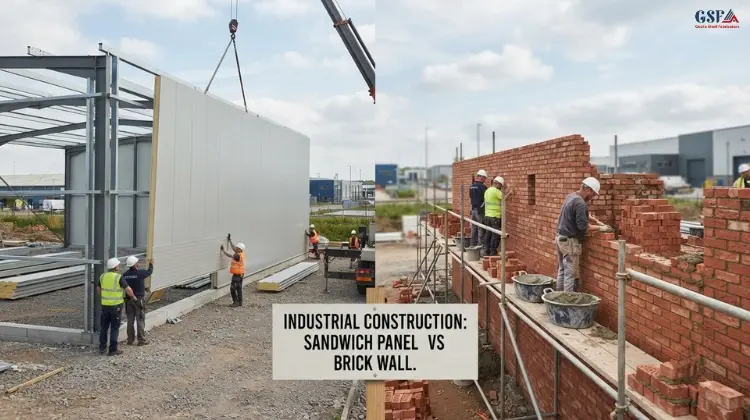
What’s the article about? This article compares sandwich panels and brick wall construction for industrial facilities, highlighting differences in insulation, construction speed, maintenance, and long-term cost efficiency.
Whether it’s an industrial facility or any other type, one of the biggest decisions is choosing the right building material. The type you select directly affects construction speed, energy efficiency, maintenance costs, and the building’s long-term performance. Of these, two of the most common options are sandwich panels and traditional brick wall construction.
The traditional construction, spanning over the years, is slowly being superseded by GSF Industries and its pre-engineered building. Modern industries are inclined towards sandwich panels for warehouse buildings, factories, logistics parks, cold storage units, and various manufacturing plants. So, if you’re planning for one too, which option is better for you – sandwich panels or brick wall construction? Let’s find out.
What are Sandwich Panels?
Sandwich panels are pre-engineered building panels consisting of two metal sheets with an insulating core such as polyurethane (PU), polyisocyanurate (PIR) or rock wool. They are fast, efficient and sustainable in nature and are widely used in pre-engineered buildings (PEBs) for structural strength, thermal insulation and fast installation.
What Do You Mean by Brick Wall Construction?
It is something that you’ve seen all your childhood. Your house is constructed with the brick wall construction method. It is the traditional technique of laying bricks one over another using mortar to create a solid structure. Widely used in residential, commercial, and industrial projects, brick wall construction is known for its strength and durability. But with time, manufacturers are moving past this method because of the time, labour, and maintenance that it takes, in comparison with modern prefabricated buildings.
Sandwich Panels vs Brick Wall Construction: 5 Key Differences
1. Construction Speed: Sandwich Panels Save Time
Manufacturers are done with postponed construction and unnecessary delays. Their projects operate on strict timelines, and even a single delay can affect the overall momentum. Brick wall construction requires multiple stages, such as masonry, plastering, curing, and finishing. Each step takes time, further depending on the weather conditions.
On the other hand, sandwich panels are factory-manufactured and installed directly onto the steel framework. Since they arrive ready-to-install, construction progresses much faster.
2. Thermal Insulation and Energy Efficiency
It isn’t new that temperature control is the most important factor in manufacturing plants, food processing units, pharmaceutical facilities, and cold storage warehouses. While traditional brick wall construction offers limited insulation and additional materials to achieve energy-efficient performance,
Sandwich panels come with a built-in insulation technique that helps to reduce heat transfer. This allows the HVAC (Heating, Ventilation, and Air Conditioning) systems to operate more efficiently. It also lowers energy consumption and improves indoor comfort throughout the year.
3. Structural Weight and Building Performance
It includes heavy materials like bricks, gravel, sand, or mortar. That is why brick wall constructions add a considerable weight to the structure, requiring stronger foundations and increasing construction costs.
Sandwich panels are lightweight, yet durable. The lower weight reduces the load on the building, making it suitable for large-span industrial buildings and modern PEB structures.
4. Maintenance and Longevity
Once an industrial construction is completed, it is expected that a building performs reliably for decades with minimal maintenance. Brick walls often develop cracks over time due to moisture and weather. It needs to be repaired through plastering, repainting, and masonry work.
Whereas a sandwich panel is manufactured with corrosion-immune coated steel and weather-resistant insulation. Requiring minimal maintenance and top performance, many industrialists are switching for good.
5. Cost of the building
The project’s overall lifecycle is a different story than its initial investment. Brick construction is time-consuming, labour-intensive, slow, and requires more upkeep.
Sandwich panels reduce labour costs, speed up construction, improve efficiency, and require less maintenance. These advantages frequently translate into higher value and lower total ownership costs. As a result, it is critical to consider not only the initial costs, but also the long-term benefits.
Which Option Is Better for Industrial Facilities?
Is there any doubt? Of course, sandwich panels! Enabling faster project completion, improving thermal performance, reducing maintenance, and supporting energy-efficient operations, panels are quicker and more effective than brick-and-mortar construction.
While brick walls can be suitable for certain conventional buildings, like residential, industries need to be productive and operational, so nothing better than a sandwich panel can fulfil that. Also, if you are looking for future scalability, prefer sandwich panels integrated with Pre-Engineered Building (PEB) systems.
Final Thoughts: Is GSF Industries a Trusted PEB Building Manufacturer
It’s not just the materials, but also the expertise of the pre-engineered building manufacturer behind the design and construction. As an experienced PEB building manufacturer, GSF Industries not only delivers a high-quality industrial building, but also one tailored to the diverse business needs. Every project is made to serve a purpose.
Therefore, businesses looking for a reliable and seasoned pre-engineered building manufacturer in Punjab now know where to come for faster construction, lower operating costs, and future-ready industrial infrastructure.
FAQs
- 1. What are the advantages of using sandwich panels?
-
Sandwich panels offer the best thermal insulation, faster installation, lightweight construction, energy efficiency, and low maintenance for industrial buildings.
- 2. How long do sandwich panels last?
-
High-quality sandwich panels typically last 30–50 years with proper installation and routine maintenance.
- 3. Is a sandwich panel waterproof?
-
Yes, properly installed sandwich panels provide excellent resistance to rain and moisture. This helps to keep industrial facilities dry and protected.
- 4. What is the standard thickness of a sandwich panel?
-
Sandwich panels come in many thicknesses ranging from 30 mm to 200 mm depending on insulation and application requirements.
- 5. How to install a sandwich panel?
-
GSF Industries offers professionally engineered sandwich panel solutions and professional installation for durable and high-performance PEB structures.
Share

