


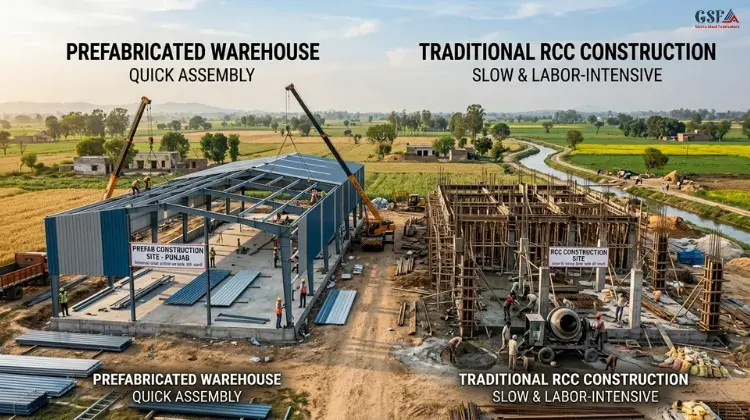
What’s the Article About? This article explains the difference between traditional RCC warehouses and modern Pre-Engineered Warehouses (PEB).
Well, we are at a point where people active in the business are constantly confused about whether they should build a traditional RCC warehouse or invest in a modern pre-engineered warehouse. While RCC stands for Reinforced Cement Concrete, quite similar to rebar, a prefabricated warehouse is also known as PEB, which has been coming to the forefront for some time. In that, Punjab is taking over the construction scene quite rapidly, becoming one of the fastest-growing industrial and logistics hubs in India. Many businessmen are looking forward to settling in the state for their needs and ease. Therefore, the question is.
For many years, RCC construction was regarded as the standard option for industrial buildings, but since GSF Industries’ PEB warehouses came onto the scene, the picture has flipped 180 degrees! One of the main reasons is speed. While RCCs take a lot of time to build, prefabricated warehouses are faster to build, cost and time-efficient, easy to expand, relatively low maintenance, and absolutely suitable for long-term operations.
While we are comparing the actual costs, let’s first properly understand what these terms really mean.
What Is a Traditional RCC Warehouse
As mentioned before, RCC, or Reinforced Cement Concrete, is a traditional and common construction method in which the entire warehouse is built on-site using cement, sand, bricks, concrete, and steel bars. Workers enrolled in RCCs require a lot of labor, and all work is done on-site, resulting in dependency on labor availability, weather conditions, material transportation, and site management. These factors result in construction delays and higher overall project costs for industries that work under tight deadlines.
Some of the business challenges that RCC construction faces include long construction periods, increased labor costs, material wastage, delayed operational start, difficult future modifications, and increased maintenance over time. Although RCC buildings are durable, businesses aren’t able to avoid challenges. Therefore, this is one of the primary reasons industries are looking into modern alternatives such as pre-engineered steel warehouse buildings.
What Is a Pre-Engineered Warehouse (PEB)
A pre-engineered warehouse, or PEB warehouse, is a new-age steel structure that is designed and built in a factory before being assembled on the job site. Unlike traditional RCC construction, which starts from scratch on-site, PEB structures use pre-designed components made with engineering minds. The ready steel sections are delivered to the job site and quickly assembled with bolts and connections, making the construction process much faster and more efficient.
For some time, businesses have been preferring PEB warehouses due to quicker project completion, reduced labor dependency, reduced material waste, easy future expansion, better storage planning, and, of course, reduced long-term maintenance. Many leading warehouse manufacturers in India, like GSF Industries, now recommend PEB structures for industrial warehouse projects due to their ultimate efficiency and long-term value.
Comparing the Actual Cost of PEB and RCC Warehouses
There are a total of 7 factors that will help to compare the cost difference between the two, because when businesses compare the two, they usually focus only on the initial building cost. But that’s not the case. The true cost of a warehouse includes much more than that, but also includes construction time, labor expenses, operational delays, maintenance costs, future expansion expenses, repair requirements, and structural efficiency.
Let’s decode each of them, one by one:
Construction Time: The Biggest Cost Factor
While a PEB warehouse can be completed in 60 to 120 days, depending upon the project size, an RCC warehouse will take 240 to 420 days for the same project size!
Isn’t it clear that a pre-engineered warehouse is the one that can be quick and profitable for your business from every angle? In an RCC, there are a lot of factors that can affect the build time, but in the case of PEBs, structures are made in the factory and assembled on site, which cuts down half the hassle.
This speed further affects operations, inventory movement, rental income (if any), production timelines, labor expenses, and material costs.
Labor and Material Costs
An RCC construction required a large workforce to mix concrete, lay the bricks, reinforce, plaster, and give finishing touches. But, in the case of a PEB warehouse building, this dependency is negligible as the structures are precision-engineered in factories; therefore, the chances of material wastage become much lower.
Maintenance and Long-Term Expenses
Maintenance costs accumulate over time and have a significant impact on total ownership expenses. A traditional RCC building may experience issues such as surface cracks, water seepage, concrete damage, structural wear, and paint deterioration. While repairing these problems regularly increases operational costs, a pre-engineered steel warehouse building offers:
- Corrosion-resistant steel structures
- Better structural flexibility
- Improved ventilation
- Large, column-free spaces
- Better roofing systems
This results in both operational capability and storage management.
Expansion Flexibility
Business requirements change over time, and at one point, they are changing constantly. An RCC warehouse built today may require expansion in a few years. This is difficult in this case, as modifying concrete buildings requires demolition, structural redesign, increased labor costs, and construction downtime, which will further trigger losses for all the good reasons.
On the flip side, a PEB warehouse building has much greater flexibility. They can be easily extended in terms of length, add additional storage sections, upgrade roofing systems, change layouts, and expand operational space. And this is exactly what makes prefabricated warehouse construction ideal for growing industries in Punjab.
Difference Between A Traditional RCC Construction and a PEB Warehouse
| FACTORS | PEB WAREHOUSE | RCC WAREHOUSE |
|---|---|---|
| Construction Time | Quite Faster | Slow-moving |
| Construction Method | Factory-made & assembled on-site | Built completely on-site |
| Labor Requirement | Limited manpower required | Very High |
| Future Expansion | Easily expanded | Difficult; required demolition and building again |
| Maintenance Cost | Downscale costs | Higher costs |
| Material Wastage | Minimal to no waste | Highly incurred |
Conclusion:
Why Punjab Industries Are Moving Toward PEB Warehouses
While RCC structures are still useful for certain applications, modern industries increasingly prefer prefabricated warehouse solutions. So, honestly, choosing between the RCC and PEB warehouse is no longer simply a matter of building type but about making the right long-term business investments. Investing in pre-engineered steel warehouse buildings can help businesses planning industrial projects in Punjab save time and money over the long term.
Working with experienced warehouse manufacturers in India, like GSF Industries, will ensure that your warehouse project is properly planned, engineered, and executed. So, choose a prefabricated warehouse manufacturer who can assist your business in creating modern, durable, and cost-effective warehouse spaces that will support long-term industrial growth.
Visit GSF Industries’ website now.
FAQs
- 1. What is a Pre-Engineered Warehouse (PEB)?
-
Pre-Engineered Warehouse is a steel structure manufactured in factory-made sections and assembled at the site. It is also known as a prefabricated warehouse or PEB warehouse building.
- 2. Why are PEB warehouses becoming popular in Punjab?
-
PEB warehouses are faster to construct, require less labor, and offer lower maintenance costs, making them ideal for industries and logistics businesses in Punjab.
- 3. Is a PEB warehouse cheaper than RCC construction?
-
In many cases, yes. While costs may vary depending on the project, PEB warehouses usually reduce overall expenses through faster construction, lower labor requirements, and reduced maintenance.
- 4. Can a prefabricated warehouse be expanded later?
-
Yes. One major advantage of prefabricated warehouse construction is easy future expansion without major demolition or reconstruction work.
- 5. Which industries commonly use pre-engineered steel warehouse buildings?
-
Industries such as logistics, manufacturing, agriculture, FMCG, food processing, and e-commerce commonly use pre-engineered steel warehouse buildings because of their efficiency and scalability.
Share

